The Perfect Haircut for Round Face: A Geometry-Based Guide to Choosing Your Cut
Stop guessing. Start measuring. The perfect round-face haircut is a math problem, not a mood board.
You’ve been told ‘add height on top’ and ‘avoid chin-length hair’ a thousand times. That’s not advice — that’s a fortune cookie. The perfect haircut for a round face is about understanding which geometric lines counteract your face’s circular outline. Here’s the step-by-step system for finding it.
Step 1: Measure Your Face Shape

Before you pick a haircut, confirm you actually have a round face. Measure three points: forehead width (temple to temple), cheekbone width (the widest point), and jawline width (just below the ears). On a round face, these three measurements are roughly equal — there’s no significant difference between forehead, cheekbones, and jaw. The face length (hairline to chin) is also similar to the face width. If your cheekbones are the widest point and your jawline is narrower, you’re heart-shaped, not round. If your jawline is the widest and most angular, you’re square. This matters because the wrong face-shape diagnosis leads to the wrong haircut — and a haircut that flatters a square face can make a round face look wider.
Timing: 5 minutes with a soft tape measure or a photo and a ruler
Prerequisites:
- Soft tape measure or ruler
- Good lighting
- Hair pulled back from face
Step 2: Identify the Lines You Need
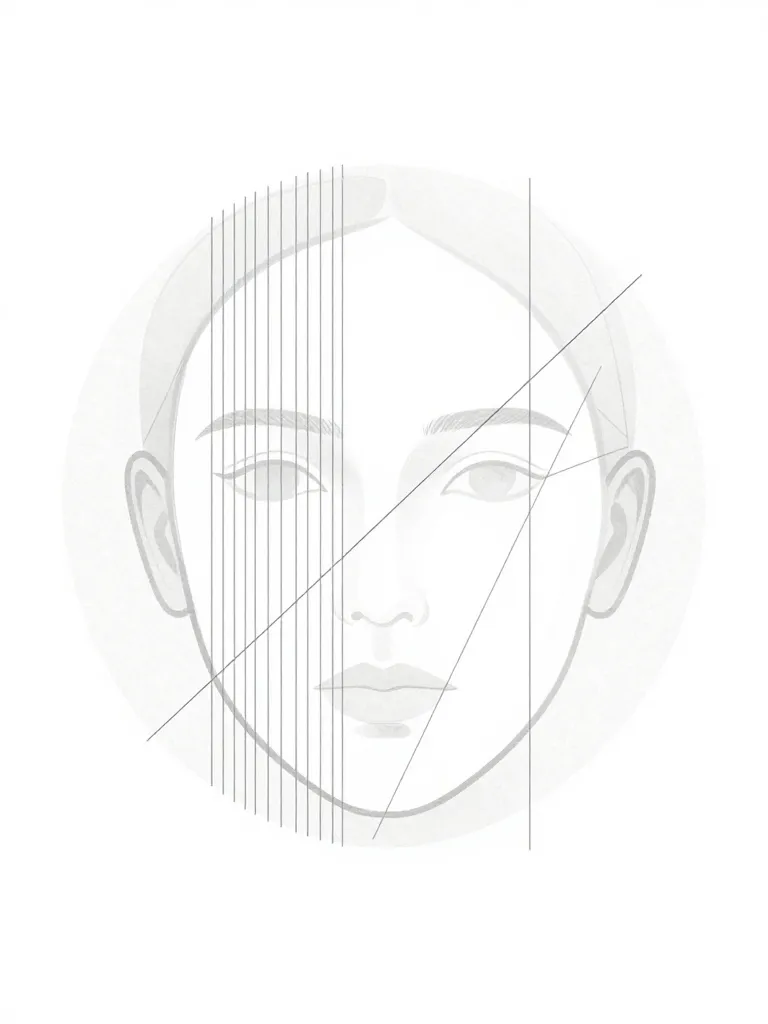
The goal for a round face is to introduce lines that counteract the circular outline. There are three types of lines that work: vertical (elongating), diagonal (dynamic, face-slimming), and angular (jaw-defining). Avoid horizontal lines (blunt bangs, chin-length bobs with no layers) — they mirror the roundness and make the face look wider. The specific lines you need depend on your features: if your forehead is wide, you need diagonal lines at the temples (side-swept bangs, asymmetrical parts). If your jawline is soft, you need angular lines at the jaw (layered cuts that end below the jaw, pointed ends). If your cheeks are the widest point, you need vertical lines at the cheekbones (long face-framing layers, curtain bangs that sweep outward).
Timing: 10 minutes analyzing your features in a mirror
Prerequisites:
- Understanding of your face shape from Step 1
- Good lighting
- Reference photos of haircuts you like
Step 3: Match the Cut to Your Hair Type

The geometric principles are the same for every hair type, but the execution changes. Straight hair needs more aggressive layering to create movement and prevent the hair from hanging flat against the face (which reinforces roundness). Wavy hair naturally creates diagonal lines, so you can get away with less layering. Curly hair creates volume that adds width — so the layers need to be longer and more spaced out to prevent the hair from puffing at the cheekbones. Fine hair needs internal layering (cut underneath, not on top) to maintain density while still creating face-framing movement. Thick hair can handle aggressive external layering without looking sparse. The worst mistake is choosing a haircut based on how it looks on someone with a different hair type — a layered cut that looks sleek on straight hair can look like a mushroom on curly hair.
Timing: 15 minutes comparing your hair type to reference photos
Prerequisites:
- Knowledge of your hair type (straight, wavy, curly)
- Reference photos of your hair type with the cut you want
Step 4: Avoid the Common Mistakes

There are three haircuts that actively work against round faces: the chin-length blunt bob (creates a horizontal line at the widest point of the face), blunt bangs (cut the forehead horizontally, making it look wider), and the all-one-length cut with no layers (the hair hangs straight down, mirroring the face’s circular outline). If you have a round face and you’re currently wearing any of these, the single biggest improvement you can make is adding layers, length, or asymmetry. You don’t need a complete overhaul — even adding face-framing layers to a blunt bob can transform it from face-widening to face-slimming.
Timing: 5 minutes checking your current cut against these mistakes
Prerequisites:
- A mirror
- Honesty
Step 5: Communicate With Your Stylist

The biggest gap between ‘the perfect haircut’ and ‘what you walk out with’ is communication. Most clients show a photo and say ‘I want this.’ What they should say is: ‘I have a round face. I need vertical lines at the cheekbones, length below the jaw, and no blunt edges at chin level.’ When you speak in terms of lines and geometry, your stylist can adapt the cut to YOUR face — not just replicate a photo on a different face shape. Ask for: face-framing layers that start at or below the cheekbone, length that goes past the jawline, and texture at the ends (not blunt cuts). If your stylist doesn’t understand face-shape geometry, find one who does — the difference is visible.
Timing: 10 minutes before your appointment
Prerequisites:
- Reference photos
- Understanding of your face shape and the lines you need
Why This Works
The perfect round-face haircut isn’t about following trends — it’s about understanding geometry. When you know which lines counteract your face shape, you can evaluate any haircut objectively instead of guessing. This system works whether you’re choosing a new cut or fixing one that isn’t flattering.
Pro Tips
- The 2-inch rule: For round faces, the most flattering length is at least 2 inches below the chin. Anything between chin and shoulder reinforces roundness.
- Part placement matters: A center part on a round face creates two equal halves that mirror the circle. An off-center or deep side part introduces a diagonal that breaks the symmetry.
- Volume placement: Volume at the crown elongates. Volume at the cheeks widens. Direct your blowout upward at the roots, not outward at the sides.
- The mirror test: Stand in front of a mirror with your hair pulled back. Then let your hair down with the new cut. If your face looks narrower, the cut is working.
The perfect haircut for a round face isn’t a specific style — it’s a set of geometric principles. Vertical lines elongate. Diagonals slim. Angles define. Horizontal lines widen. Once you understand these principles, you can evaluate any haircut and know instantly whether it will flatter your face or fight against it.
Your face shape isn’t a flaw. It’s a design constraint — and every great architect knows that constraints produce the most interesting designs.