Bangs for Round Face: Which Styles Slim and Which Make It Worse
Bangs on a round face can be the best or worst decision you ever make. The difference is geometry.
Bangs are the most polarizing haircut element for round faces. Get them right, and they create diagonal lines that slim the forehead and elongate the face. Get them wrong, and they create a horizontal shelf that makes your face look wider than ever. Here’s the complete guide to bangs for round faces — which styles work, which don’t, and how to style them for maximum face-slimming.
Step 1: Know Your Bang Options

There are four main bang types, and each one affects a round face differently. Blunt bangs: cut straight across the forehead, creating a horizontal line that widens the face. Side-swept bangs: angled from one side to the other, creating a diagonal that slims the forehead. Curtain bangs: split in the center and swept to both sides, creating two diagonal lines that frame the face. Wispy bangs: thin, feathery bangs that partially show the forehead, creating softness without a hard line. For round faces, the ranking is: curtain bangs (best) > side-swept bangs (great) > wispy bangs (okay) > blunt bangs (worst). The reason is geometry: curtain and side-swept bangs create diagonal lines that counteract the roundness, while blunt bangs create horizontal lines that reinforce it.
Timing: 10 minutes analyzing which bang type suits your face
Prerequisites:
- Understanding of your face shape
- Reference photos of each bang type
Step 2: Get Curtain Bangs Right

Curtain bangs are the gold standard for round faces. They split at the center (or slightly off-center) and sweep outward to each side, creating two diagonal lines from the center of the forehead to the temples and cheekbones. The ideal length for curtain bangs on a round face: the shortest piece hits at the eyebrow, and the longest piece hits at the cheekbone. This creates a frame that narrows the forehead and draws the eye to the cheekbones — which are the most attractive feature on a round face. The split should be clean (not wispy) so the diagonal lines are visible. Ask your stylist to point-cut the ends (cut into the ends at an angle) rather than blunt-cut them — this creates the feathery, face-framing effect that makes curtain bangs work.
Timing: 20-30 minute salon visit for bang cut
Prerequisites:
- Hair long enough to sweep to the sides (at least eyebrow length)
Step 3: Style Bangs for Face-Slimming

Bang styling is where most round-face bangs go wrong. The instinct is to blow-dry bangs straight down — which flattens them against the forehead and creates a horizontal line. The correct technique for round faces: blow-dry bangs outward and slightly upward. Use a small round brush (1-inch barrel) and roll the bangs away from the center of the forehead, directing them toward the temples. This creates volume at the roots and a sweeping diagonal line that slims the forehead. For curtain bangs, blow-dry each side separately: roll the left side to the left, the right side to the right, and let them meet at the center split. Use a cool shot to set the direction. Avoid flat-ironing bangs straight — it removes the volume and the diagonal line, leaving you with a flat, horizontal fringe that widens the face.
Timing: 5-10 minutes for bang styling
Prerequisites:
- Small round brush (1-inch barrel)
- Blow dryer with concentrator nozzle
Step 4: Maintain the Bang Shape

Bangs grow fast — about half an inch per month. On a round face, overgrown bangs lose their diagonal shape and start to hang straight down, which creates the horizontal line you’re trying to avoid. The maintenance schedule: trim bangs every 3-4 weeks. You can do this at home with sharp scissors and the point-cutting technique: hold the scissors vertically and snip into the ends at an angle. Never cut bangs horizontally — it creates a blunt line that widens the face. Between trims, use a flat iron to redirect the bangs if they start to lose their sweep. If your bangs are growing out and hitting the eyes, sweep them to the side and pin them with a small clip — this maintains the diagonal line even when they’re too long.
Timing: 5 minutes every 3-4 weeks for trimming
Prerequisites:
- Sharp hair-cutting scissors
- A mirror
Step 5: Know When to Skip Bangs
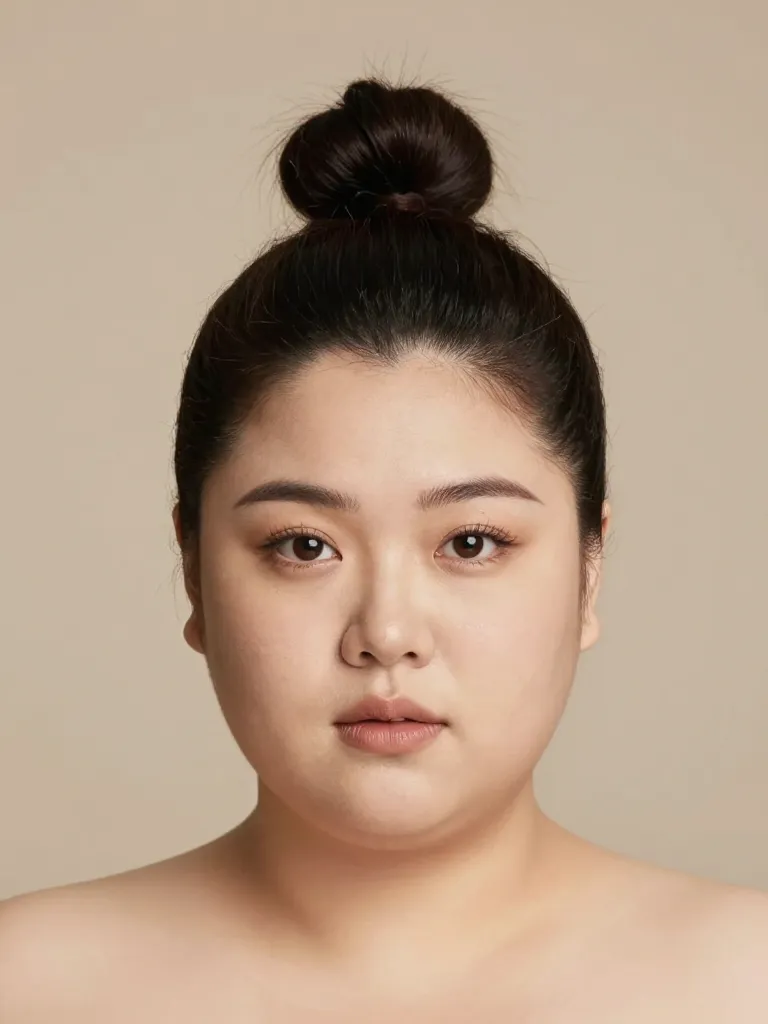
Bangs aren’t for every round face. If your forehead is small or narrow, bangs will cover it entirely and make your face look shorter — which makes it look rounder. If your hair is very fine or thin, bangs can look sparse and stringy, which draws attention to the forehead rather than framing it. If your hairline is very low, bangs will sit too close to your eyebrows and create a heavy, horizontal weight. In these cases, the better option is no bangs at all — keep the forehead exposed and use face-framing layers instead. Face-framing layers create the same diagonal lines as curtain bangs but start lower on the face (at the cheekbone or jawline), which is more flattering for small foreheads. The rule: if your forehead is average or large, bangs work. If your forehead is small, skip them and use layers instead.
Timing: 5 minutes assessing your forehead proportions
Prerequisites:
- A mirror
- Honest assessment of your forehead size
Why This Works
Bangs on a round face are a geometry decision, not a style decision. The right bang type (curtain or side-swept) creates diagonal lines that counteract the circular outline. The wrong bang type (blunt or heavy) creates horizontal lines that reinforce it. The styling and maintenance matter as much as the cut — bangs that are blow-dried straight down lose their face-slimming geometry.
Pro Tips
- The diagonal rule: Any bang that creates a diagonal line slims a round face. Any bang that creates a horizontal line widens it. Simple.
- Bang length matters: Bangs that hit at the eyebrow or below create a stronger frame than bangs that sit above the brow.
- Off-center split: Split curtain bangs slightly off-center (not dead center) — it adds more asymmetry, which further slims the face.
- Dry shampoo your bangs: Bangs get oily faster than the rest of your hair. Dry shampoo keeps them fresh and prevents them from going flat.
Bangs for round faces are a high-risk, high-reward decision. Get the geometry right (diagonal lines, not horizontal), style them correctly (outward, not downward), and maintain them regularly (every 3-4 weeks), and they’ll be the most powerful face-slimming element in your haircut. Get any of those wrong, and they’ll widen your face faster than any other haircut mistake.
Your round face deserves bangs that work with it, not against it. Now you know the difference.